Microbial computing: Review and Perspectives, Biotechnology Advances
Engineering microbial computers has been a longstanding endeavor in synthetic biology. Like other unconventional computing disciplines, the goal is to bring computation into real-world scenarios.
Several potential applications in bioproduction, bioremediation, and biomedicine highlight the promise of this discipline. The first biocomputers were bottom-up predictable circuits that relied on a monoculture-based digital logic and were able to emulate simple logic gates. Drawing from computer theory and extending the analogy with conventional hardware has enabled the engineering of more complex circuits. However, this abstraction soon reached its limits and introduced a semantic gap, which, alongside the constraints imposed by the monoculture paradigm, led to significant scalability limitations such as metabolic burden, orthogonality issues and noisy expression.
This review outlines the strategies developed to overcome these issues and engineer more complex biodevices: (i) mitigation strategies that focus on the optimization of the circuits, (ii) multicellular computing that distributes the metabolic load across a consortium and (iii) the implementation of more energy-efficient computing frameworks, such as analog and neuromorphic architectures. While these bottom-up strategies have yielded significant progress, they remain insufficient to emulate the computational complexity of the cellular signal-processing system.
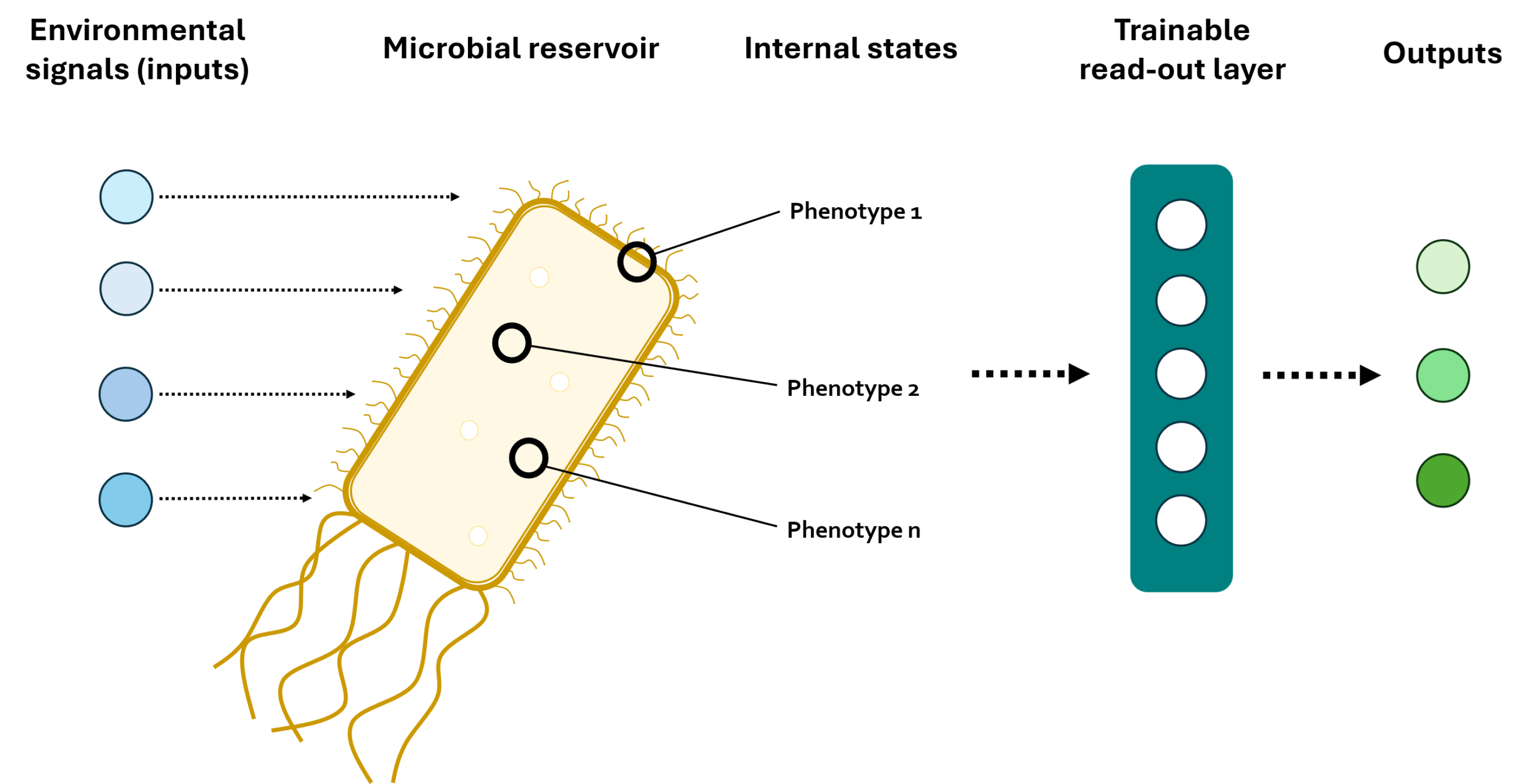
In this review, we additionally introduce a new perspective on biocomputing with a top-down approach named reservoir computing. This framework leverages the inherent dynamical computational capabilities and functionalities of biosystems to solve more complex and diverse tasks, thus offering a promising new path for engineering the next generation of microbial computers.
Ref: Avahi P, Le Gouellec A, Faulon JL. Microbial computing: Review and perspectives. Biotechnology advances, 2025. doi: 10.1016/j.biotechadv.2025.108766