What if the computer was already alive?
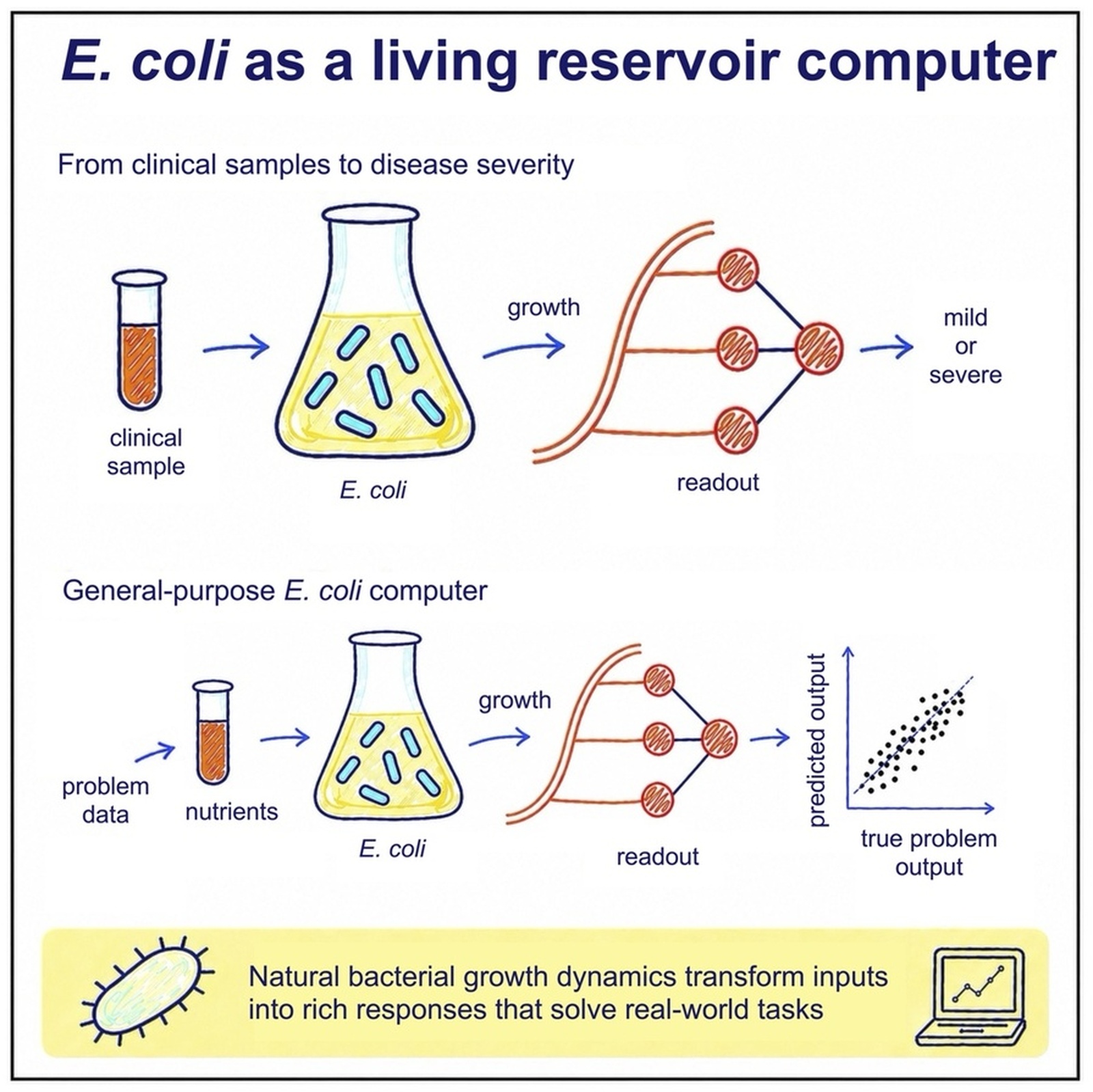
Sensing and computing with living cells usually means engineering them — rewiring genetic circuits, adding synthetic parts. It’s powerful, but hard: metabolic burden, low noise tolerance, fragile behavior at scale.
We asked the opposite question. Instead of building a device bottom-up, could we repurpose an organism as-is to compute?
Our paper, Living bacterial reservoir computers for information processing and sensing, is now published in Cell Systems. In it, we use E. coli as a living reservoir computer — no genetic modification, no specialized instrumentation, only its natural growth responses.
From growth curves alone, the system classifies early-stage COVID-19 plasma samples according to subsequent disease severity. And beyond that clinical application, the same bacterial growth solves benchmark machine-learning classification and regression tasks, outperforming linear and MLP baselines.
What’s most exciting is what it opens up: a low-cost, infrastructure-light route to biosensing and diagnostics, and a new way to think about the computational capacity already present in living systems.
Huge thanks and congratulations to the whole team who made this happen. 🎉
Work funded by BIOS Horizon Europe, PEPR B-BEST and the ANR AMN project — thank you for your support!
📄 Read it here: https://www.cell.com/cell-systems/fulltext/S2405-4712(26)00136-5
📄 Communiqué de presse: https://www.inrae.fr/actualites/bacterie-capable-predire-levolution-dune-maladie