Reverse engineering molecules from fingerprints through deterministic enumeration and generative models, Journal of cheminformatics
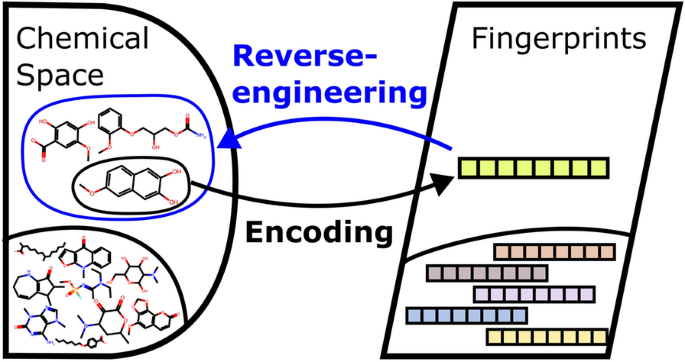
Reverse engineering in molecular design aims to identify optimal structures based on activities, or properties, computed through molecular descriptors like fingerprints. This task is known to be particularly difficult for the widely used Extended-Connectivity Fingerprints (ECFPs), due to significant loss of structural information during vectorization.
While recent artificial intelligence-based works have raised awareness about the privacy risks associated with ECFP-based data sharing, we contribute a more conclusive demonstration by introducing a deterministic algorithm that reconstructs molecular structures from ECFPs.
Using MetaNetX and eMolecules as databases of natural compounds and commercially available chemicals, the deterministic algorithm benchmarks a Transformer-based generative model trained to predict SMILES from ECFPs. The generative model achieves a top-ranked retrieval accuracy of 95.64% but struggles with exhaustive enumeration. Additionally, applying the deterministic method to a drug dataset reveals its potential for de novo drug design, as many of the reverse-engineered structures are found to be patented or supported by bioassay data.
Ref: Meyer P, Duigou T, Gricourt G, Faulon JL. Reverse engineering molecules from fingerprints through deterministic enumeration and generative models. Journal of cheminformatics, 2025. doi: 10.1186/s13321-025-01074-5